Tuesday, June 19, 2007

Home About us Event Rates

HOW YOU CAN GET INTO THE
What is Serious Fitness?

Serious Fitness
,
is a company founded by Alberto Siri, it provides a comprehensive and unique approach helping people discover true health which enables them to prevent illness and develop optimum health without the use of drugs.
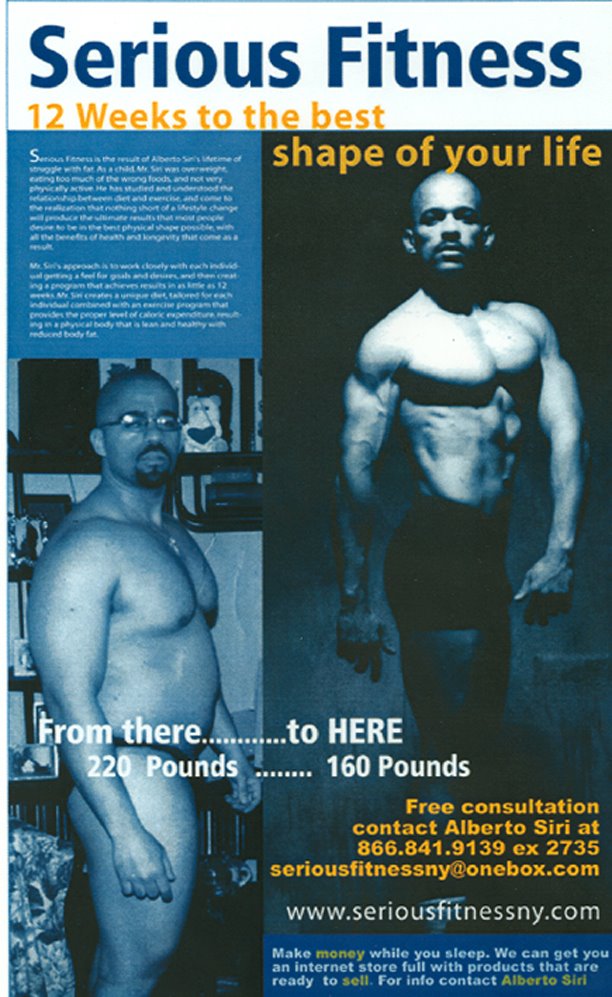
It is an exclusive, private personal training and nutrition company based in New York City. Our specialty is in home, fitness centers and office personal training. We create and implement individualized fitness programs that are designed to help you achieve your objectives fast, safely and efficiently. We specialize in custom designing the body you want in twelve weeks or less. Our customized fitness regimen that we develop for you will combine a number of protocols that are intended to boost your strength, increase your stamina and improve your overall health and appearance regardless of your current fitness level guaranteed.


The Amazing physical transformation in 12 weeks.

Our flagship product, Professional Fitness Training and Nutrition, provides all the great tools you would expect from a Professional Trainer that will deliver the results that you dreamed of.

Our services are designed to meet the needs of people of all cultures, ethnicity and sex. We are committed to providing the best Personalized Fitness and Nutrition service, at a very competitive rates and we pride ourselves for being extremely responsive and available to all customers. We guarantee delivering fast and permanent results that you will enjoy for the rest of your life.

Contact us at 1 347 575 2845 or email us at serious.fitness@live.com today to find out how our services will help you discover how to have the body and health you dreamed of.

Change Someone's Life Tell - A - Friend


How do I reach Alberto Siri ?

Serious Fitness
(Professional Fitness Training Schedule:


Monday-Friday, 8am-12pm, 2pm-7pm
Saturday, 8am-5pm
Closed Sunday

Please call 1-2 weeks in advance to make an appointment.

Inwood, NY :
By Subway take the 1, A to 207th St. walk South to 206th St. Between 9 Ave. & 206th St.
Bus: M.100 or Bx. 7 to . to Bway & 207th St. walk East toward 206th St.
between 9 Ave. & 10 Ave.

Midtown East:
East 54th St. 1 Ave.
By Subway take the E,6 to 53 St./Lexington Ave.
By Bus: M.15 to 54 St.

Contact Alberto Siri:
Mobile: 1 347 575 2845
email:serious.fitness@live.com


Wednesday, September 20, 2006

Dear Friends,

Are you a New Yorker looking for the most results-driven and personalized fitness program available? If so, then this might be the most important letter you'll ever read.
l would like to start by asking, what are your health and fitness goals? What obstacles are challenging you to achieve them? To learn more about Serious Fitness, please Click here

    • Are you tired of having energy highs and lows throughout the day?

    • Do you want to increase your metabolism?

    • Would you like to have a functional, muscular body that can perform like a high performance sports car throughout the day?

    • Would you like to fit back into those pants that looked great on you in years past?

If you've answered "Yes" to any of these, I'm glad you found my website.

I can help you. For seventeen years, I've been obsessed with finding out the best ways to get in shape. I've invested over $50,000 on my academic and post-academic training to learn the latest science. I've have read many books and magazines to learn from the best "in the trenches" practitioners. Now, I can deliver what I've learned to you.

What I do is so much different than traditional personal training. In fact, I’d probably be more accurately described as a coach, rather than a trainer. Are you paying for someone to stand over you counting reps OR are you paying for RESULTS? Results come from accurate information personally applied to each individual client, not rep-counting. For example, my clients learn ...

• How to set powerful goals that virtually guarantee success

How to develop a priority system that keeps you laser-focused on achieving the results
you desire

• How to balance your muscle conditioning program to look and feel like a Greek God
or Goddess

How to eat for maximum energy, strength, and fat loss
• Find out the best times to exercise for your particular goals and lifestyle.

Find out the best exercises to increase the release of that muscle-building and fat-loss hormone.
• Find out what daily choices we make can drastically affect how we look and feel
Find out how to increase your metabolism every time you eat
• Find out how some of the best-selling fat loss supplements can actually sap you of your energy and ability to lose fat
Find out why most popular diets slow your metabolism to a snail’s pace
• Find out the best way to exercise to improve your mood (not all exercise is equal)
Find out the best exercises to help you prevent low-back flare-ups
• Find out how too much exercise can actually be detrimental

Three Reasons to Believe What I Say

Reason One: I have a proven track record of results - For the last fifteen years, I've helped clients reach their fitness goals after they faced years of frustration and confusion. Many times, I was the second, third, or fourth trainer they had worked with, and as they pleasantly found out, my unconventional strategies produced results when nothing else had.

Reason Two: My formal education, rare in the fitness industry, allows for a wider perspective than typical trainers.

My academic and in-the-trenches background in exercise physiology and exercise nutrition helps my clients mold their physiques to their desired goals. My Masters Degree work in
Exercise Psychology helps clients stay focused on their goals with powerful goal-setting and visualization techniques.

Reason Three: I am a recognized leader in the personal training field.

I say that not to brag, but my leadership role allows me to work with other leaders in the field on a daily basis. When I don't know something, the answer is only a phone call away. Imagine the benefit this brings to my clients. My clients essentially have access to my entire network.


Warning: Do NOT Hire A Fitness & Nutrition Coach Unless They Meet
The Following 5 Criteria


There is a lot of confusion surrounding the health and fitness field and choosing to hire a personal trainer. I want to give you 5 criteria a good coach absolutely, positively must have:

1. They Must Be Certified By a Nationally Accredited Institution

The gold standard for certification agencies are the American Council on Exercise, National Strength & Conditioning Association, and American College of Sports Medicine. A qualified trainer should at minimum have a certification with one of these agencies. But that just means they’ve passed the “baseline of standards” to call themselves a personal trainer. It does not mean they are good at what they do or can deliver a specific result. There is a big difference between a “trainer” and a “fitness professional”.

2. They Should Do More Than Just “Take You Through A Workout”

A top quality fitness professional does more than just “take you through a workout”. Anyone can count to 15 by themselves and hold a clipboard. Look for a coach who will educate you about all the components necessary to achieve optimal health and a fitness result. Your trainer should review nutrition education with you, educate you about proper supplementation, review resistance training (whether that be balance training, core work, Stability balls, medicine balls, etc.), Cardiovascular exercise to maximize fat burning, flexibility to avoid injury and speed recovery, and really walk you through all the steps that encompass the “mental development” side. Goal setting, putting together a plan of action, and then holding you accountable and supporting you through the entire process is absolutely critical to your success.

3. Ask for Proof of Results

A top fitness pro should be able to do more than just talk about results- they should be able to prove they deliver. Ask for proof of client results. Do they have before & after photos of clients, testimonials, references? Can you speak with a client to inquire about their experience working with them? If a fitness pro can’t offer this kind of concrete proof than be careful.

4. Ask For A Guarantee

According to a Consumer Reports study there is more dissatisfaction in the fitness and diet industry than any other. That’s crazy. Think about it- if you took your car to a mechanic you’d expect it to be fixed- not come back with 2 or 3 pings and a loose belt! Working with a fitness professional should be the same as any other industry. If they aren’t willing to guarantee your results then find someone who will. Spending your time and energy without a guarantee of results is like going to that terrible mechanic! Don’t waste your money or more importantly your time working with someone who can’t offer an iron clad guarantee of your success.

5. Look For Someone That Will Empower You For Life!

A great fitness coach will do more than just help you to achieve your goals. A true professional will teach you the foundation of knowledge so you will no longer be lost in the “sea of confusion” when it comes to all the diet and exercise hype. The foundation of knowledge and correct technique you’ll learn will allow you to maintain your results for life!

A Stronger and Leaner Future Awaits You

If you've come this far with me, one thing is for certain, you probably want to be in better shape. So you're now faced with one of two choices:

1. Stop reading, surf the net or watch TV. Do nothing for yourself and remain unsatisfied with your appearance and health.

2. Set up an initial consultation with me and change your life for the better.

I certainly hope you go for option #2 because doing so will give you the health, fitness, confidence, and happiness that you really want and deserve.

The word “tomorrow” has been described as the most harmful word in the English language. In the words of Apollo Creed in Rocky III, I submit to you “There is no tomorrow!” Take action today. Schedule an initial consultation today. I rarely offer free consultations, but I am offering one to you today. Take advantage of this limited time opportunity.


Believe It . . . You Can Achieve Your Best Body Ever With Serious Fitness.

Tuesday, August 15, 2006


Good Health—What Can You Do About It?

“PARTLY as a result of some spectacular successes of modern medicine, an attitude has spread to many parts of the world that health is something the doctors provide for people, instead of something that a community and individuals achieve for themselves.” So wrote Dr. Halfdan Mahler in World Health, the official journal of the World Health Organization.

Of course, doctors and hospitals do contribute a great deal to our health and well-being. Nonetheless, they play essentially a curative role. We seek their services when something is wrong, but we seldom think about them when we feel well. What, then, can we do to achieve good health for ourselves?

Guidelines for Healthful Living

In general, experts are agreed that good health depends on three major factors: balanced diet, regular exercise, and responsible living. There is certainly no lack of information on these subjects, and much of it is practical and beneficial. Some pertinent and current ideas on how diet and exercise relate to our health are presented in the boxes “Your Diet and Your Health” and “Exercise, Fitness, and Health.”

Although much helpful information is available, the facts show, regrettably, that achieving good health is not very high on most people’s list of priorities. Among other things, “everybody knows what is required to lose weight,” remarked Dr. Marion Nestle of the Office of Disease Prevention and Health Promotion in Washington, “yet the prevalence of overweight doesn’t seem to change much.” According to her office, about 1 in 4 people in the United States is more than 20 percent overweight.

Similarly, a study by the U.S. National Center for Health Statistics reveals: “In general, between 1977 and 1983 there appears to have been an increase in unfavorable health practices.” What are these “unfavorable health practices”? They are not problems over which the individual has no control, such as malnutrition, epidemics, or pollution. Rather, they are factors that are entirely the responsibility of the individual—practices such as smoking, overeating, overdrinking, and drug abuse.

Clearly, more than medical or scientific information on what to do to achieve good health is needed. A greater incentive to live up to our individual responsibility is necessary. We must be motivated not only to do those things that will contribute to good health but also to avoid those things that will tear it down. Where can we find such incentive and motivation to help us live healthy lives?

Though most people may not be aware of it, a doctor-author, S. I. McMillen, commented in the preface of his book None of These Diseases: “I am confident that the reader will be intrigued to discover that the Bible’s directives can save him from certain infectious diseases, from many lethal cancers, and from a long gauntlet of psychosomatic diseases that are increasing in spite of all efforts of modern medicine. . . . Peace does not come in capsules.”

We can see from these comments that although the Bible is not a medical textbook or a health manual, it does provide principles and guidelines that can result in wholesome habits and good health. What are some of these principles?

Emotions and Outlook on Life

For example, “medical science recognizes that emotions such as fear, sorrow, envy, resentment and hatred are responsible for the majority of our sicknesses,” said the above-quoted Dr. McMillen. “Estimates vary from 60 per cent to nearly 100 per cent.”

What can be done to remedy this? Interestingly, some 3,000 years ago, the Bible pointed out: “A calm heart is the life of the fleshly organism, but jealousy is rottenness to the bones.” (Proverbs 14:30) But how does one get “a calm heart”? The Bible’s counsel is: “Let all malicious bitterness and anger and wrath and screaming and abusive speech be taken away from you along with all badness.” (Ephesians 4:31) In other words, to enjoy good physical health, we must learn to control our emotions.

This, of course, is contrary to the advice of some modern psychiatrists and psychologists. They often recommend that we act out our feelings rather than try to control them. Letting off steam and venting one’s anger may bring temporary relief to the one who feels hemmed in and disturbed. But what does that do to his relationship with those around him, and what kind of reaction may that trigger on their part? It is not difficult to imagine the tension and frayed nerves, not to mention the possible physical injury, that would result if everyone acted out his feelings rather than tried to control them. It merely creates a vicious circle that never ends.

Of course, it is not easy to master these harmful emotions, especially if one is prone to give in to anger and rage. That is why the Bible goes on to say: “Become kind to one another, tenderly compassionate, freely forgiving one another.” (Ephesians 4:32) In other words, it says that we should replace the harmful negative feelings with positive ones.

What do such positive feelings toward others do to us? “Caring is biological,” writes Dr. James Lynch in his book The Broken Heart. “The mandate to ‘love your neighbor as you love yourself’ is not just a moral mandate—it’s a physiological one.” Regarding the benefits that such positive relationships bring, Robert Taylor, a psychiatrist, adds: “Knowing you have people you can turn to in times of need can provide some very important feelings of security, optimism and hope—all of which can be great antidotes to stress.” Thus, while modern medicine may try to come up with cures for some of what are called psychosomatic illnesses, the simple directives of the Bible can help to prevent them from occurring in the first place. Anyone who is willing to apply the Bible’s guidelines will benefit emotionally and physically.

Habits and Addictions

Something else that affects our emotional and physical well-being is the way we treat our body. With reasonable effort on our part—eating properly, getting the needed exercise and rest, keeping clean, and so on—our body will care for itself. However, if we habitually abuse it, sooner or later it will break down, and we will suffer the consequences.

The Bible’s advice is: “Let us cleanse ourselves of every defilement of flesh and spirit.” (2 Corinthians 7:1) How can we apply such advice, and what are the benefits? Consider the following report by the Washington-based Worldwatch Institute: “Smoking is an epidemic growing at 2.1 percent per year, faster than world population. . . . Growth in tobacco use slowed briefly in the early eighties, primarily for economic reasons, but is resuming its rapid increase. Over a billion people now smoke, consuming almost 5 trillion cigarettes per year, an average of more than half a pack a day.”

What has been the effect of this ‘growing epidemic’? The accompanying box gives some sobering food for thought. The list is by no means exhaustive, but the message is clear: Addiction to tobacco is both powerful and costly. It is a defiling habit that damages the health of both the addicted and those around them.

What about efforts to stop the habit? In spite of all the antismoking campaigns, success has been minimal on a worldwide scale. This is because overcoming the tobacco habit is a strenuous uphill battle. Research shows that only 1 in 4 who smoke ever succeed in breaking the habit. Apparently all the warnings that smoking is a health hazard are not incentive enough.

However, the Bible counsel quoted above, along with its injunction for Christians to love their neighbors as themselves, has moved thousands who are now Jehovah’s Witnesses to stop smoking. Whether at their Kingdom Halls, where they meet for several hours each week, or at their conventions, where thousands of them meet for days, you will not see any of them with a cigarette. Their willingness to accept and apply the Bible’s directives has given them the needed determination to accomplish what others fail to achieve.

Other harmful practices include overindulgence in alcohol, drug abuse, promiscuous sex with possible deadly diseases resulting from it, and a host of other troubling health and social problems. Although health authorities are hard-pressed to deal with these problems, you will find that the Bible provides advice that is both reasonable and practical.—Proverbs 20:1; Acts 15:20, 29; 1 Corinthians 6:13, 18.

When All Sickness Will End

However much we may try to maintain good health, the hard fact remains that, at present, we get ill and die. Yet, the Creator of man, Jehovah God, not only tells us why man gets sick and dies but also tells us about the time that is soon coming when all sickness and even death itself will be overcome.—Romans 5:12.

A Bible prophecy at Isaiah 33:24 promises: “No resident will say: ‘I am sick.’” Revelation 21:4 also promises: “And [God] will wipe out every tear from their eyes, and death will be no more, neither will mourning nor outcry nor pain be anymore.” Yes, the Creator’s promise is a new world right here on earth, where mankind will be raised to human perfection, with vibrant health and everlasting life being the lot of the human family!—Isaiah 65:17-25.

Your Diet and Your Health

“If you . . . do not smoke or drink excessively, your choice of diet can influence your long-term health prospects more than any other action you might take.”—Dr. C. Everett Koop, former U.S. surgeon general.

In recent years, health experts have spoken out on the harmful effects that certain aspects of the diet of industrialized nations have on people’s health. Besides calling attention to such things as tobacco, alcohol, salt, and sugar, special emphasis has been given to the fact that the diet of many people is too high in fat and cholesterol and too low in fiber.

“Of greatest concern,” continues Dr. Koop, “is our excessive intake of dietary fat and its relationship to risk for chronic diseases such as coronary heart disease, some types of cancers, diabetes, high blood pressure, strokes and obesity.” Similarly, British surgeon Dr. Denis Burkitt and others have been calling attention to the link between dietary fiber deficiency and coronary heart disease, bowel cancers, gastrointestinal disorders, diabetes, and other diseases.

Not all the details of how our diet affects our health are understood, nor is there total agreement among all health professionals. Yet, there are some medical facts that are well worth our consideration.

Cut Down the Fat

A high level of cholesterol, a fatty alcohol, in the blood is directly related to a high risk of heart disease. Those with heart disease or a family history of it, and those who want to minimize the risk, would do well to keep blood cholesterol at a safe level. What can be done?

The first line of defense usually recommended is to follow a diet low in cholesterol, found in all animal foods, such as meats, eggs, and dairy products, but not in plant foods. Recent studies have found, however, that eating cholesterol-rich foods alone has only a moderate effect on one’s blood cholesterol level. But if the diet is also rich in saturated fats (such as animal fats, vegetable shortening, and palm and coconut oils), the rise in blood cholesterol is considerable in most people. Thus, the emphasis nowadays is ‘cut down on fat.’ Eat less and leaner meat, cut out the visible fat, remove the skin from poultry, and limit consumption of egg yolks, whole milk, hard cheeses, and processed foods that contain palm or coconut oil.

While saturated fats have the tendency to raise the blood cholesterol level, unsaturated liquid oils (olive, soybean, safflower, corn, and other vegetable oils), fatty fish, and shellfish work just the opposite. Some of these may even help to raise the relative amount of a so-called good cholesterol, the HDL (high-density lipoprotein), in the blood or lower the level of the damaging kind of cholesterol, the LDL (low-density lipoprotein).

Eat More Fiber

Cutting down on fat is only part of the story. Highly refined and processed foods—loaded with white flour, sugar, chemical additives, and so forth—are totally deficient in fiber. The result is the so-called civilized diseases: constipation, hemorrhoids, hernia, diverticulosis, colorectal cancer, diabetes, heart disease, and others. “Men with a low intake of dietary fiber had a three times higher risk of death from all causes than men with a high intake,” says a report in Lancet.

Dietary fiber plays its role in two ways. It absorbs water as it moves through our digestive system, and it passes through our digestive tract quickly. Health experts feel that it takes with it many of the harmful agents and speeds up their removal from the body. Some soluble fibers are found to hold down the sugar and LDL cholesterol levels in the blood—a boon for diabetics and heart patients.

How can you benefit from this knowledge about fiber? If possible, increase the proportion of fruits, vegetables, and whole-grain products in your diet. Switch from white to whole-wheat bread and add whole-grain cereal to the breakfast table. Beans are also an excellent source of fiber. And starch—potatoes and rice—may have anticancer properties.

There are, of course, many other aspects of your diet that affect your health. However, cutting fat and increasing the fiber are the two areas in most people’s diet needing urgent attention.

Exercise, Fitness, and Health

A 40-year study of some 17,000 men found that those who exercised as little as an hour or two a week (using up about 500 calories) had death rates 15 to 20 percent lower than those had who did not exercise. Those who exercised vigorously (burning 2,000 calories a week) had a death rate one third lower. Other studies have reached the same conclusion: Regular exercise reduces the risk of high blood pressure, coronary heart disease, and perhaps even cancer. Regular exercise also helps in the fight against overweight, low self-esteem, stress, anxiety, and depression.

The reason regular exercise seems to do all of this is that it raises a person’s physical capacity and endurance. In other words, regular exercise makes one physically fit. While fitness does not guarantee good health, a physically fit body is less likely to succumb to ailments. It also recovers faster when it does get ill. Physical fitness may contribute to one’s mental and emotional well-being as well as slow down the effects of aging.

What and How Much?

The usual questions about exercise are, What kind of exercise, and how much? That really depends on what one wants to accomplish. An Olympic athlete must train long and hard to remain fit. For most people, the goal may be to lose weight, to get in shape, to enjoy better health, or just to feel well. For them, most health experts agree, 20 to 30 minutes of exercise three times a week is needed to keep fit. But what kind of exercise?

Fitness involves one’s physical capacity, age, and endurance, so exercise should aim to elevate one’s rate of heartbeat and breathing during the workout. This is what is commonly called aerobic exercise. Running, brisk walking, aerobic dancing, rope skipping, swimming, and cycling are common forms of aerobic exercise, each with its advantages and disadvantages in terms of convenience, cost of facilities and equipment, chance of injury, and so on.

Other forms of exercise strengthen the muscles and shape the body. These include workouts with exercise machines and weights. Such exercises increase one’s physical strength and endurance and can improve one’s posture and appearance as well—all pluses in the pursuit of a fit body.

What about the calisthenic exercises that most of us remember only too well from our school days? They did us a lot of good, whether we appreciated them at the time or not. Stretching, turning, and twisting limber up the body. Jumping and kicking speed up the heart rate. Sit-ups, push-ups, and chin-ups strengthen the muscles. A great advantage of such stretching exercises as one ages is that one may remain limber and able to continue active longer.

Finally, there are the recreational sports—tennis, racquetball, softball, skating, and many other activities. The advantage of such activities is that they are more fun than monotonous forms of exercise and therefore may be the element needed to make a person exercise regularly. Depending on how skillfully and how vigorously one pursues them, such activities may or may not provide the sustained level of exertion as do other forms of exercise. Nonetheless, they help condition the body, improve coordination, and enhance flexibility and agility.

With so many forms of exercise to choose from, the secret of success lies in picking one, or a combination of them, that you would enjoy. This will help you to stick to your intentions, since studies show that from 60 to 70 percent of adults who start to exercise quit within a month or so. Remember, it is the regularity, not just the amount, of exercise that matters. By engaging in different kinds of exercise at different times, you will also give your body well-rounded development, becoming fit in a balanced way.

Your choice of activity should also be governed by your age and your general condition of health at the outset. Of course, those with health problems should consult with their doctor before embarking on an exercise program. In any case, start out slowly, and increase as you make progress. Learn about the forms of exercise you choose—there is no shortage of books and instructions on the subject—and you will both enjoy and benefit from your efforts.

The Cost of Smoking

· Tobacco causes more suffering and death among adults than any other toxic material in the environment.

· The worldwide cost in lives now approaches 2.5 million per year, almost 5 percent of all deaths.

· Health expenditures plus economic losses in [the United States] range from $38 thousand million to $95 thousand million, or from $1.25 to $3.15 per pack. These totals do not include the cost of tobacco itself—about $30 thousand million per year.

· Passive smokers are perhaps three times as likely to die of lung cancer as they would be if they were not exposed to smoke.

· Smoking by mothers diminishes the physical and mental capabilities of their children, and in many countries more than one fifth of the children are exposed to smoke in this way.

Contac
t
Alberto Siri, Professional Fitness Trainer &
Nutritionist
Tel / fax: 1-866-841-9139 x 2735

seriousfitnessny@onebox.com